
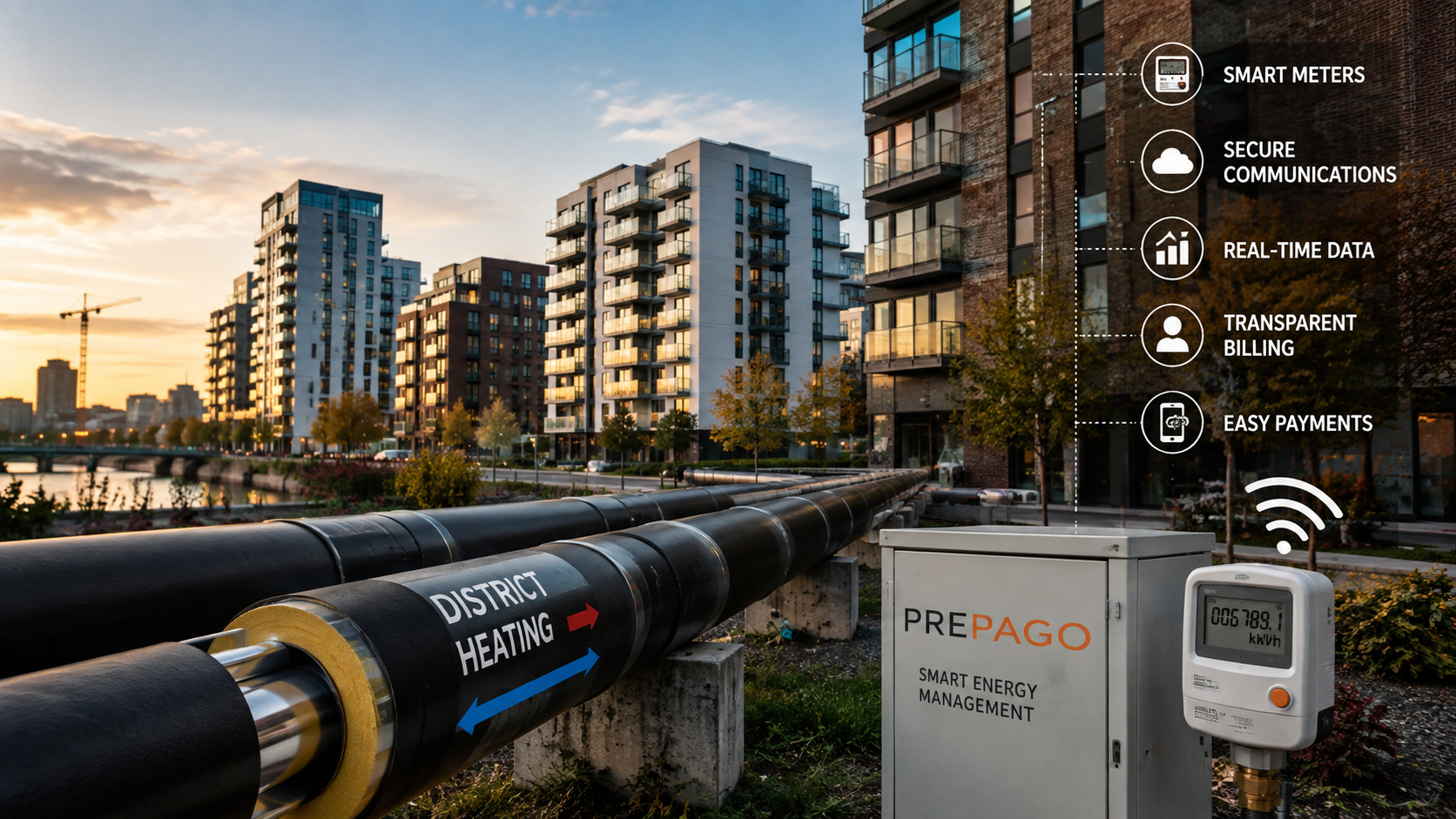
Ireland’s heating system could be approaching one of its biggest changes in decades.
In July 2026, the Government advanced new Heat Bill legislation intended to provide the framework needed for district heating to expand across Ireland.
District heating remains relatively unfamiliar to many Irish consumers, but the principle is straightforward. Instead of every apartment, home or commercial building producing heat independently, heat is generated centrally and distributed to multiple buildings through a network of insulated pipes.
The opportunity for Ireland is significant.
Government and energy-sector research has indicated that district heating could ultimately provide a substantial proportion of Ireland’s heating needs, with approximately 80% of Dublin's heat demand potentially suitable for district heating by 2050.
For developers, local authorities, housing providers and energy operators, that creates an entirely new category of infrastructure to build and manage.
Ireland already has a working example
District heating is not just a future concept.
The Tallaght District Heating Scheme in South Dublin has been operating since 2023 and uses waste heat recovered from a nearby data centre.
The network initially supplied buildings including South Dublin County Council offices, Tallaght Library and Technological University Dublin facilities.
It was subsequently extended to serve Work IQ and 133 cost-rental apartments at Innovation Square.
South Dublin County Council reports that the network saved approximately 1,265 tonnes of CO₂ during 2024 and a further 1,422 tonnes during 2025.
The council is now investigating additional expansion opportunities.
Tallaght demonstrates something particularly important for Ireland: energy that would otherwise be discarded as waste can become a useful local resource.
From wasted heat to useful energy
Ireland has several characteristics that make district heating particularly interesting.
Large urban populations create concentrated heating demand, while facilities such as data centres, energy-from-waste plants and industrial sites can produce significant amounts of excess heat.
Instead of releasing all of that heat into the environment, district-heating networks can capture suitable sources and distribute the energy to nearby buildings.
The Poolbeg area provides another major example of the opportunity.
Dublin Waste to Energy already produces energy from waste, and plans associated with the facility envisage district heating potentially serving tens of thousands of homes.
As more networks emerge, Ireland's heating infrastructure could begin to look very different from the traditional model of an individual boiler in every property.
Building the network is only half the challenge
Much of the discussion around district heating understandably concentrates on energy sources, pipes and energy centres.
However, once hundreds or thousands of individual customers are connected, another challenge begins.
Someone still has to accurately determine how much energy every property consumes.
Tariffs need to be applied.
Meter readings need to reach the operator reliably.
Residents need to understand what they are consuming and what they are paying.
Payments need to be collected.
Operators need visibility across the network.
Problems such as abnormal consumption, communications failures and meter faults need to be identified quickly.
As Ireland moves from small demonstration projects towards larger commercial district-heating networks, the digital infrastructure sitting above the physical heat network will therefore become increasingly important.
The importance of individual heat metering
A district-heating system may supply an entire apartment development from one central energy source, but individual residents still need an accurate measurement of their own consumption.
Connected heat meters make this possible.
Rather than relying on manual meter-reading visits, a networked system can collect readings remotely and associate consumption with individual properties and customer accounts.
For an operator managing hundreds of apartments, this changes heat metering from a periodic administrative exercise into a continuously connected service.
It also creates the foundation for clearer customer information.
Residents can have greater visibility over consumption and account balances, while operators gain a much clearer picture of what is happening across the network.
Where Prepago fits into the district-heating transition
Prepago provides connected metering, billing and prepayment technology designed specifically for shared-energy environments including communal and district-heating networks.
Our platform connects the different operational layers required to manage these systems, from meter communications and data acquisition through to customer accounts, payments and operator oversight.
Because district-heating developments do not all use identical equipment, interoperability is particularly important.
Prepago's approach is hardware-neutral and designed to work with existing and new metering infrastructure using technologies including M-Bus and other building and metering communication protocols.
This means an operator may not necessarily have to replace an entire installed metering estate simply to introduce modern remote management and customer services.
Turning meter data into useful information
Remote metering does more than eliminate manual readings.
Regular meter information can help an operator understand how a development is actually consuming heat.
Usage patterns can highlight unusual behaviour, unexpected consumption or potential equipment issues.
Centralised monitoring also makes it easier to manage large numbers of properties without treating each apartment as an isolated system.
Prepago combines meter communications with an operator platform that gives energy providers and property managers visibility across connected properties.
For residents, web and mobile technology can provide straightforward access to their own energy account.
The result is a digital layer connecting the energy centre, the meter, the operator and the customer.
Transparent billing will matter as the sector grows
Consumer confidence will be particularly important as district heating becomes more common.
For many Irish households, moving into a district-heated property will be their first experience of purchasing heat from a network rather than paying an electricity or gas supplier to operate their own heating appliance.
That makes clarity especially important.
Customers need to be able to understand their consumption, tariffs, account balance and payments.
At the same time, heat-network operators need systems capable of managing individual consumption charges alongside standing charges and other network costs.
Automating much of this process reduces administration while giving customers clearer information about their own energy use.
Prepayment can remove a major operational problem
Traditional utility billing also exposes operators and property managers to arrears.
Across a large residential development, unpaid utility accounts can become a significant administrative and financial burden.
Prepago's Pay-As-You-Go approach allows customers to maintain their energy balance in advance through connected digital services.
For operators, this can substantially reduce the debt and revenue-collection problems associated with conventional retrospective billing.
For customers, it provides much more immediate visibility of their available balance and energy expenditure.
A new generation of Irish energy infrastructure
District heating will not replace every heating system in Ireland.
But in dense urban developments, apartment schemes and areas located near suitable renewable or waste-heat sources, it could become an increasingly important part of the country's energy system.
Ireland is now beginning to put the legislation, funding and infrastructure around that opportunity into place.
The Government has already allocated €5 million towards pre-construction support for efficient district-heating projects, while longer-term public investment is intended to help establish the core infrastructure for a national district-heating market.
The opportunity is therefore moving beyond individual pilot projects.
The next stage will be building networks that can operate reliably at scale.
And as those networks grow, successful district heating will depend on more than pipes and heat exchangers.
It will require accurate metering, dependable communications, transparent customer accounts, flexible billing and software capable of managing thousands of individual energy relationships.
That is where connected energy technology becomes part of the infrastructure itself.
Planning a district-heating or communal-energy project?
Prepago works with developers, energy operators, property managers and housing providers to deliver connected metering, billing and prepayment systems for shared-energy networks.
Whether the project involves a new district-heating development or the modernisation of an existing communal-heating network, Prepago can assess the installed metering and communications infrastructure and design an appropriate route towards connected management.
Talk to Prepago about your district-heating, communal-energy or metering project.